The SamuraiReading comprehension worksheet · B1–B2 · with answer key
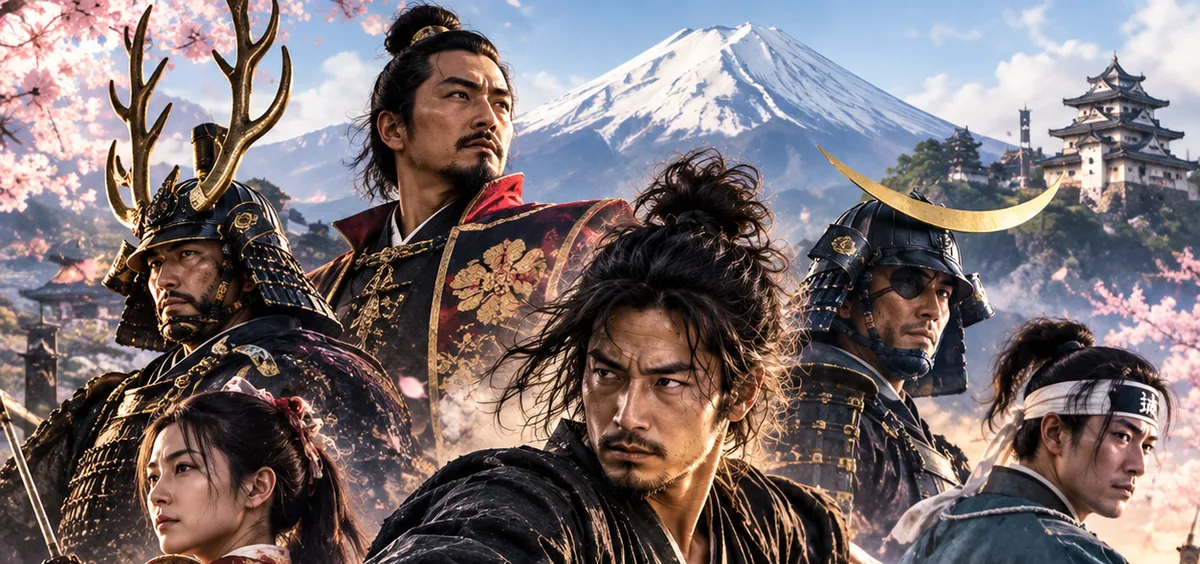
Four short chapters on Japan’s warrior class: who they actually were, what they actually fought with, how their battles were actually won, and the women the story usually leaves out.
The passage is 846 words and is followed by 19 questions and a full answer key. Free to download and print — no sign-up and no email address.
⬇ Download the worksheet (PDF, 5 pages)What you get
| Level | CEFR B1–B2 (intermediate) — teenagers and adults |
|---|---|
| Passage | 846 words, in four chapters and twelve numbered paragraphs |
| Questions | 5 multiple choice · 4 written answers · 8 vocabulary items · 2 open questions |
| Answer key | Included, with sample answers and a note for the teacher |
| Length | 5 pages (3 for the reading and questions, 1 answer key) |
| A4, portrait | |
| Price | Free. No account, no email address. |
Read the passage
This is the full text of the worksheet. The numbers are the paragraph numbers the questions refer to.
01 · Who Were the Samurai?
1 The word itself tells you where they began. Samurai comes from an old verb, saburau, which means “to serve”. They did not start as lords. To keep order, landowners armed the men who worked for them. Little by little, these armed servants became indispensable; then they became powerful; and in the end they became the government.
2 What matters is that samurai were a social class, not a job. Their height was the Edo period (1603–1868), when they made up roughly six per cent of the population — perhaps two million people. They alone were permitted to carry two swords. And most of them never fought anyone: they were armed clerks, inspectors, tax officials and guards.
02 · Weapons and Armor
3 The katana is what everyone pictures, and it is the wrong picture. For most of samurai history the main weapon was the bow, over two metres long. Later, on crowded battlefields, the spear took over. The sword was a sidearm.
4 The blade itself, though, was a remarkable object. The smith began with tamahagane, steel made from iron sand, and folded it again and again to spread the carbon evenly. He then painted the blade with clay — thin along the cutting edge, thick along the back — and plunged it into water. The thinly covered edge cooled instantly and became extremely hard; the back cooled slowly and stayed springy, so the blade could bend instead of snapping. The curve appears at that moment, by itself. A second craftsman, the polisher, then spent weeks bringing out the hamon, the wavy line where the two kinds of steel meet.
5 How a sword was carried mattered too. A mounted warrior slung a long tachi from his belt with the edge facing down. A man on foot pushed a katana through his sash with the edge facing up, so that drawing and cutting became one movement. With a short sword beside it, the pair was called the daisho — “big and small”.
6 Between the blade and the hilt sat the tsuba, the guard. It stopped the hand from sliding onto the edge and balanced the weapon, and because it could be taken off and swapped for another, it was the one part of a sword that its owner could decorate as he pleased. During the long peace of the Edo period, specialist makers turned the tsuba into a small iron picture — cut through with waves, cranes or maple leaves, inlaid with gold and copper — and museums outside Japan now collect them as sculpture.
7 Armor changed with the fighting too. The early o-yoroi was a heavy box-shaped suit for a mounted archer, built from hundreds of small scales laced together with silk cord. It looked magnificent, but the cord soaked up rain, froze in winter and was slow to repair. It was the gun that changed how armor was made. Armorers began firing at their own breastplates and sold only the armor that did not break. Above it sat a tall crest, and often an iron face mask with a moustache, which held the helmet cord in place and frightened whoever stood in front of it.
03 · The Age of Samurai Battles
8 Between 1467 and 1600 Japan tore itself apart. The Onin War began as a quarrel over who should succeed the shogun, burned much of Kyoto and left nobody in charge. In the century that followed, warfare grew from a few hundred mounted men into collisions between tens of thousands. Most of those men were ashigaru — foot soldiers taken from the villages, drilled to move in blocks and carrying spears up to five metres long, which they brought down like clubs as often as they used the point.
9 In 1543 a Portuguese ship brought matchlock guns to the small island of Tanegashima, and Japanese smiths copied them within a year. Moving a large army was also a problem in itself. In the noise and the smoke, orders travelled by conch shell, drum and flag, and warriors wore small banners upright on their backs so that their own side could tell who was who.
10 Castles changed as well, from wooden forts on mountain tops into the stone-based fortresses with white towers that visitors photograph today. A castle was rarely taken by storm. A siege did the work instead: the attackers would quietly buy up the rice around the castle in advance and starve the defenders out, or dam a river and flood them out.
11 Three battles are worth remembering. At Okehazama in 1560, Oda Nobunaga attacked an army perhaps ten times the size of his own during a thunderstorm and killed its commander. At Nagashino in 1575, Nobunaga’s gunners fired from behind wooden fences and broke the finest cavalry in Japan. At Sekigahara in 1600, about 160,000 men met in a narrow valley in thick fog, and the battle turned when one commander changed sides in the middle of it. Tokugawa Ieyasu won, and Japan had a single ruler again.
04 · The Women Who Fought
12 Not every samurai was a man. Women of the warrior class were trained with the naginata, a curved blade on a long shaft, and were expected to defend the household when the men rode away.
The questions
Part A · Comprehension
Five multiple-choice questions, one from each chapter and one that crosses two of them. They are written so that a student who has skimmed will pick the familiar-sounding answer rather than the correct one.
Part B · In your own words
Four questions answered in full sentences, each pointing at a numbered paragraph. One asks students to explain a process in their own words — why the clay on a blade was thin at the edge and thick at the back — which is harder than it looks and makes a good writing task.
Part C · Vocabulary
Eight words taken from the passage, matched to their meanings: indispensable, sidearm, springy, hilt, magnificent, collisions, siege, cavalry. Each one is given with its paragraph number, so students go back into the text rather than guessing.
Part D · Think about it
Two open questions with no single right answer. The first asks why the sword, and not the bow or the spear, became the symbol of the samurai. The second asks what happens to a warrior class once an ordinary farmer with a gun can defeat a warrior who has trained since childhood. Both work as a short class debate.
A note on the history
Where the record is uncertain, the passage says so rather than smoothing it over. The number of firearms in sixteenth-century Japan, for example, and the size of the army at Okehazama, are both disputed, and the text is worded to show that.
The chapter on women is deliberately short. Women of the warrior class were trained with the naginata and were expected to defend the household — that much is not in doubt, and the worksheet says only that.
Copying and sharing
Free to print and photocopy for home, school and classroom use. Please do not resell it or re-upload the PDF elsewhere — link to this page instead.